A square wave one or two octaves below the note, to put under another oscillator and make a bass deeper and heavier.
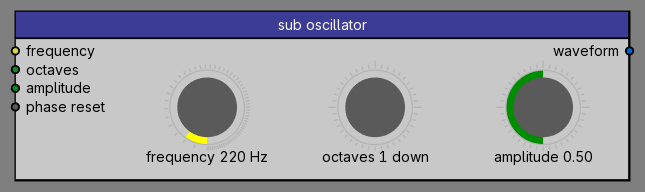
In the menu: sources, then oscillators.
Each setting has a knob, which disappears when something is connected to its input.
Many synthesizers have a sub oscillator: a simple square wave, locked an octave or two below the main oscillator, which you can mix in to make the sound bigger without changing its character much. The main oscillator gives the tone its colour; the sub underneath gives it weight. This node is that sub oscillator: give it the same frequency as your main oscillator and it plays the octave, or two octaves, below.
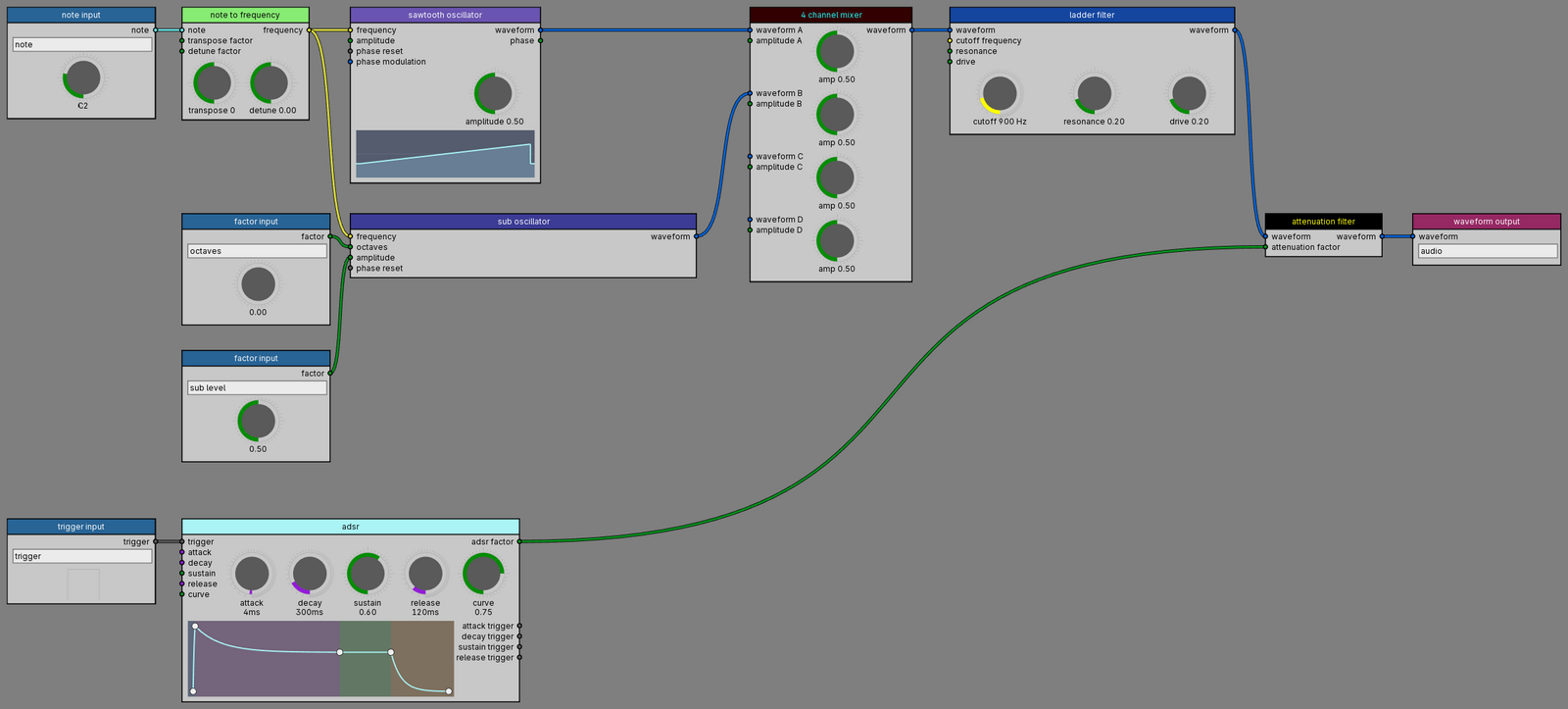
Here it is under a sawtooth bass, through a ladder filter. A bassline plays three times: with no sub, then with the sub an octave down, then with it two octaves down:
On good speakers or headphones, the sub makes the bass rounder and heavier; on small speakers, where the lowest notes can't be reproduced, you'll hear less of a difference, especially two octaves down.
It's cheaper and simpler than a second full oscillator set to the octave below, and it follows the main oscillator's frequency automatically.
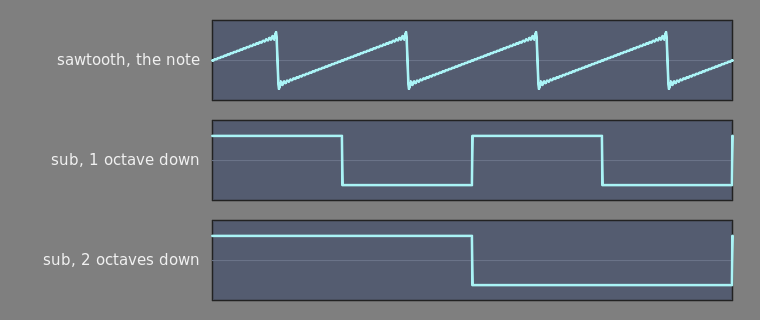
A sub an octave down adds a new fundamental at half the note's frequency, with its own odd harmonics at 1.5, 2.5, 3.5… times the note's frequency. Mixed with the main oscillator, which has its harmonics at whole multiples of the note, the combination is a tone one octave lower, but with the upper oscillator's harmonics louder than the lower one's: the classic sound of the octave-down sub on the Juno-106 and SH-101, and much of the weight of house, techno and drum and bass basslines. Two octaves down adds partials at odd multiples of a quarter of the note's frequency (0.25, 0.75, 1.25…), a darker, more rumbling, more organ-like weight (the SH-101 also offered this).
The sub and the main oscillator run at exactly related frequencies, so their relationship within a note never drifts. But if both run freely, they start each note at a random phase relative to each other, which changes the combined waveform's shape and its peak level, and with it the punch of each note's attack. Resetting both from the note's trigger makes every note identical; leaving them free makes a slightly varying, "analogue" bass.
Mix the sub in with the main oscillator before the filter, as the synth above does, so the filter acts on both: then a filter sweep keeps the sub's square from sounding separate. Since the sub's job is the low end, a few dB under the main oscillator is usually plenty: too much and the bass gets muddy and eats the mix's headroom. Its square wave has strong odd harmonics, which is what makes an octave-down sub audible on small speakers at all; if you want a purer weight, put it through its own low pass filter, or use a sine oscillator at half the frequency instead.
The node keeps a phase φ that steps by the frequency over 2 or 4 times the sample rate:

and makes its square as the difference of two band-limited sawtooths half a cycle apart, read from the sawtooth oscillator's tables at the level and fade for the sub's own frequency (see the sawtooth oscillator), so it's alias-free. With saw(φ) = 2φ − 1, the difference is +1 for the first half of each cycle and −1 for the second, so the square needs no offset. The step and level are recomputed only when the frequency or octaves change. A rising edge of phase reset sets φ to 0.
The octaves knob is a factor like any other: below 0.5 is one octave down, 0.5 and above two, so a factor input, or a trigger through a trigger to factor converter, can switch it.
Back to Sources: oscillators