Up to seven sawtooth waves at once, each a little out of tune with the others, for the huge, shimmering "supersaw" of trance leads, string machines and big pads.
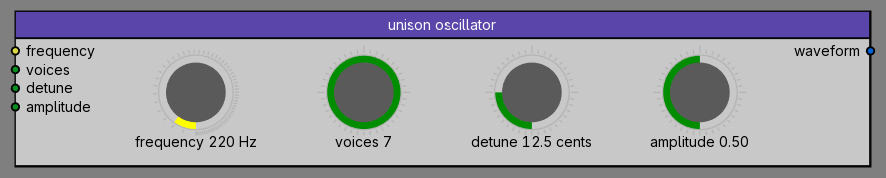
In the menu: sources, then oscillators.
Each setting has a knob, which disappears when something is connected to its input.
Imagine a violin section. Every player is playing the same note, but no two are perfectly in tune with each other, and the tiny differences make the sound move and shimmer in a way one violin never does. The unison oscillator does the same thing with sawtooth waves: it plays several at once, spreads their tuning evenly around the note, and lets them drift in and out of step with each other.
Here's one voice, a plain sawtooth, beside seven:
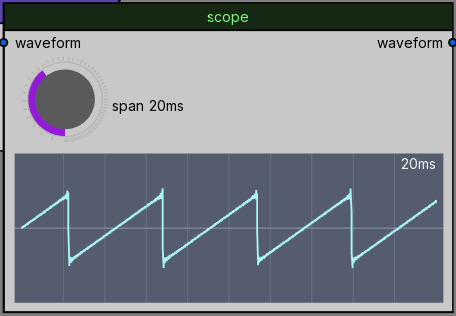
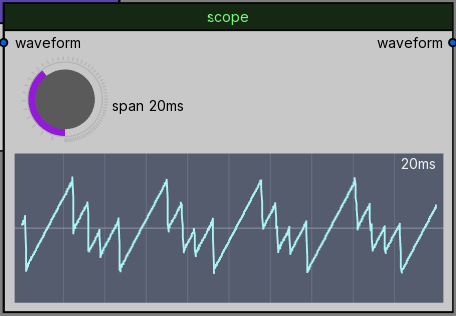
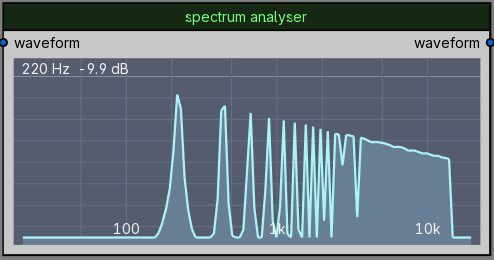
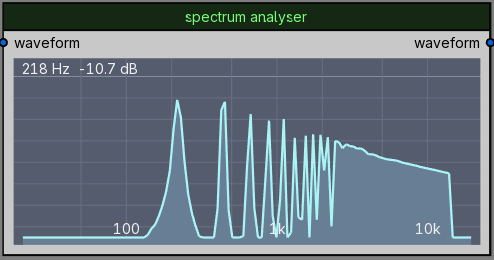
On the spectrum analyser, the seven voices still show the same harmonics as one sawtooth, but each is now a cluster of seven pitches close together, so the peaks are broader, and the higher ones are wider still:
Listen to an A minor chord on one voice, then four, then seven:
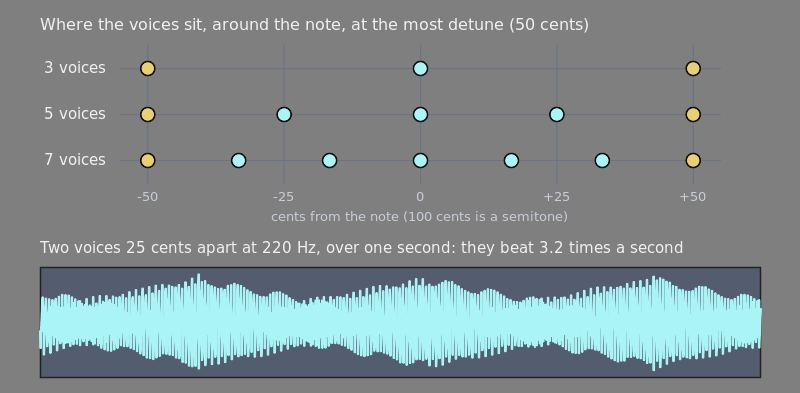
The detune sets how far apart the voices are tuned. A little detune makes a slow, gentle shimmer; more makes a fast, wide, chorus-like swirl; a lot starts to sound out of tune, or deliberately sour, like an old string machine or an accordion:
Each voice starts at a random point in its cycle when the node is made, and then they all run freely, so the pattern of the shimmer never quite repeats, and no two notes sound exactly alike.
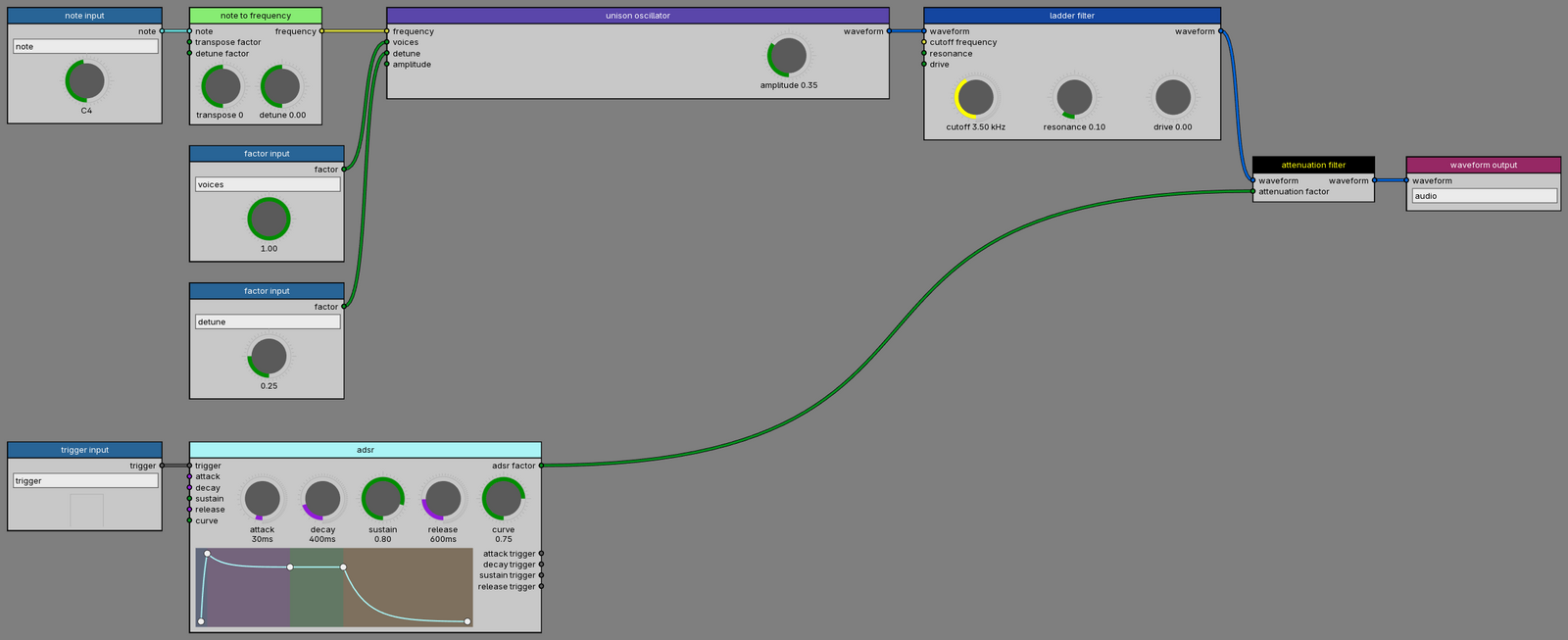
This synth plays the unison oscillator from notes, with a ladder filter to tame its top and an adsr shaping each note's loudness. Its voices and detune are synth inputs, so each note can set its own:
On a bass, too much detune smears the low notes: the beating at low frequencies is slow and lurching, and the low end loses its punch. Fewer voices, less detune, or a sub oscillator underneath for the fundamental are the usual cures.
The idea is Roland's: the JP-8000 of 1996 offered a "super saw", seven detuned sawtooths, and it became the sound of trance and much of the dance music since. This oscillator spreads its voices evenly in pitch (equal cents) between −d and +d, with the middle one exactly on the note when there's an odd number of them. With seven voices at a detune of 0.25, the voices are at −12.5, −8.3, −4.2, 0, +4.2, +8.3 and +12.5 cents.
Two tones f₁ and f₂ apart beat at |f₁ − f₂| Hz. For voices c cents apart at a frequency f, that's f (2^(c/1200) − 1), about 0.058% of f per cent: at A3 (220 Hz), the outermost voices at ±12.5 cents beat 3.2 times a second at the fundamental, and every harmonic beats proportionally faster, the tenth harmonic 32 times a second. So the higher harmonics of a unison sound shimmer faster than the low ones, and higher notes shimmer faster than low ones: a fixed detune in cents sounds livelier the higher you play.
As a rule of thumb, detunes up to about 10 cents sound like richness or chorus, 10 to 25 like the wide supersaw, and beyond that the ear starts to hear separate, out-of-tune pitches. With many voices the beating becomes a dense, noise-like modulation of each harmonic rather than a clear "wah-wah".
Voices with random phases add up in power rather than amplitude, so the output is divided by √n, keeping its loudness about the same for any number of voices. The peaks of the sum still vary from moment to moment (seven voices can sometimes line up), so leave some headroom after it. Because the voices are free-running, there's no phase reset: every note starts somewhere different in the pattern. Run through a stereo effect, or two unison oscillators panned apart, the supersaw also gets its characteristic width.
Voice v of N (counting from 0) plays at a ratio of the frequency spread evenly in cents from −50d to +50d, where d is the detune setting:

(and 1 when N = 1). Each has its own phase, started at a random value when the node is made, and reads the same band-limited sawtooth tables as the sawtooth oscillator, at its own level and fade (see the sawtooth oscillator), so every voice is alias-free at its own pitch. The output is

The ratios, steps and levels are recomputed only when the frequency, voices or detune change; each sample costs one table read (two during a level fade) per voice. For uncorrelated phases, E[(Σ saw)²] = N E[saw²], so the √N keeps the RMS level constant; the peak level of the sum, with all voices momentarily aligned, can reach √N times one voice's: about 2.6 for seven voices, before the amplitude.
Back to Sources: oscillators